

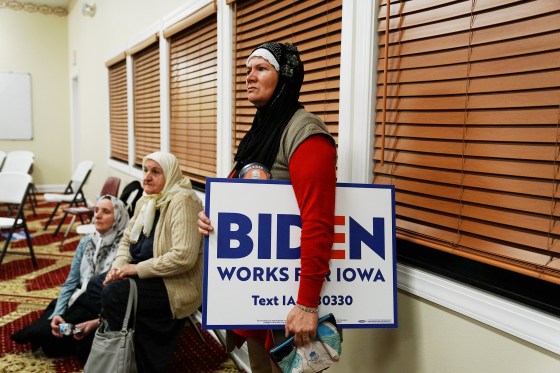
Nusaiba Mubarak isn’t the biggest fan of Joe Biden, but she’s putting her heart into getting every last Muslim voter to cast a ballot for him anyway. “I’m not satisfied with the Democratic candidate,” she says. “But I’m doing everything I can to get Trump out of office.”
Mubarak, who is Muslim, isn’t alone in her sentiments. A recent CAIR poll found that just 18% of Muslim voters support Donald Trump, while 71% say they back Biden. But that disparity hardly guarantees that Muslims will vote for Biden in droves: the former Vice President will only benefit from his opponent’s dismal popularity if he can convince Muslim voters, some of whom feel disengaged by the Biden campaign, to go through the trouble of casting a ballot.
Turn-out matters: while Muslim Americans make up just about 1% of the U.S. population, the community carries outsized weight in several swing states, including Florida, Ohio, Virginia, Wisconsin, Pennsylvania and, of course Michigan, where Trump won by less than 11,000 votes in 2016. He hosted a campaign rally in Lansing, Mich., on Tuesday.
On issues that are important to the Muslim community, there’s no real comparison between the two major candidates. Trump has routinely used Islamophobic rhetoric; championed the so-called Muslim ban, which blocks entry to the U.S. for immigrants and refugees from some Muslim-majority countries; and backed a host of federal policies, including sweeping surveillance programs that disproportionately harm Muslim Americans.
Biden, in contrast, has not actively antagonized most Muslim voters so much as failed to convince them to rally behind him, Mubarak says. Biden has pledged to revoke the Muslim ban on his first day in office; promised that a Biden Administration “will look like America, with Muslim Americans serving at every level”; and has published policy agendas targeted at helping the Muslim-American and Arab-American communities. While such campaign promises are not enough, says Mubarak, she urges her fellow Muslims not to discount the “breadcrumbs”: “It is the first time that we really have a seat at the table,” she says.
Avoiding a second Trump term, says Mubarak, who leads a voter mobilization team at MoveOn.org, means—at least in part—turning out Muslim voters in key swing districts. And that requires a two-step process: reminding Muslim Americans of the stakes of a second Trump term and giving them good reason to bother showing up at the polls. That second factor, she says, is a key part of her mission between now and Nov. 3.
A community ‘worth their while’
Historically, neither Democrats nor Republicans have spent much time reaching out to the Muslim community because it’s so small. “Political campaigns have never seen that community as worth their while,” says Youssef Chouhoud, an assistant professor of political science at Christopher Newport University. But in recent years, that calculus is starting to shift.
One reason is demographics: while a large number of Muslim Americans immigrated after the 1965 Immigration and Nationality Act, which lowered barriers to immigration from Asia, Africa and other regions outside Europe, their children are often American-born. Those who are just coming of voting age have had a very different experience of America. Many only know a post-9/11 world. “They’re adults now and they’ve known nothing but attacks on their community,” says Abed Ayoub, director of the Arab American Anti Discrimination Committee, a civil rights organization.
Another reason is an uptick in political engagement nationwide—which has partly been a response to President Trump’s Islamophobic rhetoric and policies, experts say. In the battleground states of Florida, Ohio, Michigan, and Virginia, Muslim voter turnout jumped 25% from the 2014 to 2018 midterm elections, from 130,000 votes to more than 285,000, according to Emgage, a Muslim American civic engagement group. Muslim voter outreach efforts are growing, too. In 2015, for example, the Georgia Muslim Voter Project was founded “in response to the Islamophobic rhetoric coming out of the presidential race at the time,” coupled with relatively low turnout among Muslim Americans, says the organization’s executive director, Umer Rupani.
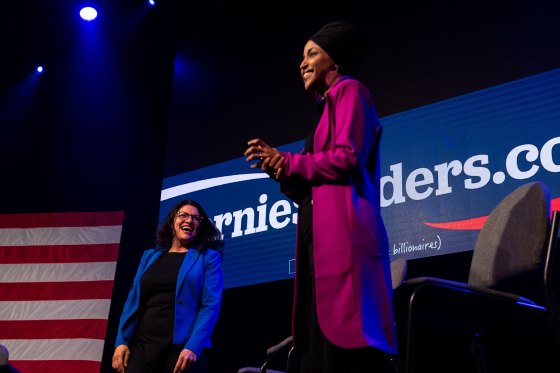
In recent years, Muslim Americans have also successfully run for elected office at nearly every level of government. In 2018, Reps. Rashida and Tlaib and Ilhan Omar became the first Muslim women elected to the U.S. Congress, and in 2019, Virginia state senator Ghazala Hashmi became the first Muslim American elected to that state’s senate. Hashmi says she ran directly in response to the “Trump administration’s attacks on the Muslim community.” (She is now a co-chair of the Asian American and Pacific Islanders for Biden Leadership Council in Virginia, working to help turn out Muslim votes for Biden.)
The issues that are important to Muslim voters have also shifted. Before 9/11, most Muslim Americans engaged with American politics largely through the lens of foreign policy, particularly with regard to Israel and Palestine, Chouhoud says. But an August CAIR poll found that civil rights, followed by healthcare, were the most pressing priorities for Muslim Americans. Foreign policy trailed behind them. In fact, More than 60% of Muslim Americans support a single payer health care system like the Medicare for All plan touted by Bernie Sanders, according to a CAIR poll from March. (Sanders was popular across the Muslim community not only for his domestic politics but also for being an outspoken supporter of Palestinian human rights, frequently speaking at Muslim events and hiring a Muslim American campaign manager.)
Racial identity—especially at this fraught moment in American politics—also plays a role in shaping Muslim voters’ political attitudes, says Chouhoud. About 60% of Muslim adults are immigrants and roughly a fifth identify as Black, according to Pew. While roughly 50% of Muslims who identify as white approve of Trump’s job performance—on par with white Americans in general—only 21% of Arab Muslims and 20% of Black Muslims do, according to a 2020 American Muslim Poll conducted by the Institute for Social Policy and Understanding (ISPU), a nonprofit that uses research to advocate for Muslim Americans. (Chouhoud, also an ISPU fellow, helped with data analysis on the poll.) Roughly 60% of Muslims also report experiencing religious discrimination, especially in interactions with law enforcement, according to the ISPU poll.
Biden’s ‘modest’ proposals
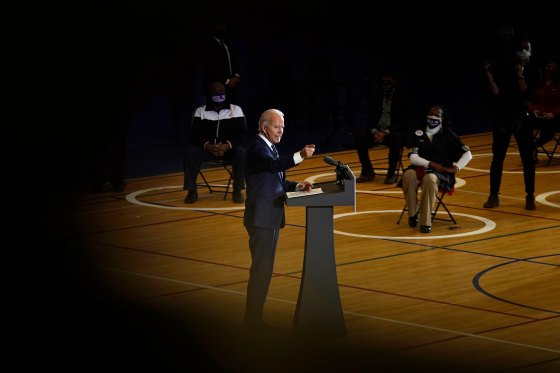
While the Biden campaign’s outreach to the Muslim community has not been as substantive as many organizers and activists, including Mubarak, would have liked, many Biden backers tout the effort. Farooq Mitha, Biden’s senior advisor for Muslim engagement, says the campaign has held more than 150 events with Muslim communities and rolled out a future Biden Administration agenda that includes policies that Muslim voters may cheer. For example, the campaign has committed to ending the Targeted Violence and Terrorism Prevention Program that civil rights advocates say unfairly targets Muslims. Mubarak says that commitment came after she, along with a group of former Muslims for Bernie, fought for it. (Mubarak previously worked as the national Muslim and Arab-American organizer for the Sanders campaign.)
The Brennan Center for Justice says Biden’s campaign promises are “modest in terms of specifics” but “signal something of a shift towards recognizing that our counterterrorism laws and policies systematically target and discriminate against some Americans.” Biden’s colloquial use in the first Presidential debate of the term “inshallah,” which means God-willing, was also welcomed as a light-hearted, if insubstantial, attempt at connection with Muslim Americans.
But it hasn’t been all smooth sailing for the Biden team. The campaign’s first hire overseeing Muslim voter outreach was Amit Jani, who led the Asian Americans and Pacific Islanders (AAPI) coalition. Jani’s appointment sparked controversy after reports surfaced that he supported the Hindu nationalist BJP party in India, which openly discriminates against Muslims. (Mitha became the campaign’s senior adviser for Muslim engagement in March; Jani remains on the Biden campaign as the AAPI director.)
In August, the Biden team again alienated some Muslim voters when a campaign spokesperson said Biden “condemns” the views of Palestinian-American activist and former Sanders surrogate Linda Sarsour, after she spoke at a a Democratic National Committee event. Sarsour had said, “The Democratic Party is not perfect, but it is absolutely our party in this moment.” Sarsour has previously been outspoken in her support for a boycott, divestment and sanctions against Israel. Several national Muslim organizations issued statements expressing their disappointment in the Biden campaign, which later privately apologized to activists, according to the Middle East Eye.
Some Muslim activists have also expressed concern about Biden’s position on Israel and Palestine, an issue of deep importance to most Muslim voters, says Palestinian-American activist and former Sanders surrogate Amer Zahr. Biden, for example, has refused to commit to tying U.S. aid to Israel to the country’s compliance with international law. He has also said he would not return the U.S. embassy to Tel Aviv, after Trump moved it to Jerusalem in May 2018. Biden has, however, said that he opposes Israeli settlement expansion.
Zahr says that although doesn’t agree with Biden on many issues, he plans to vote for him. He notes that under Islamic law, Muslims are allowed to eat pork when faced with extreme hunger but when normalcy returns, the prohibition is back in effect. He says, “The 15 minutes I’ll take to vote for Biden is like eating the unavoidable ham; Trump is hunger and starvation.”
The Biden campaign’s association with Emgage, the civic advocacy group, has also sparked some disagreement. (Mitha, Biden’s outreach coordinator, is a former co-founder of Emgage.) Emgage has been an engine for the get-out-vote effort in swing states. The organization says that more than 439,000 Muslims contacted by them and their partners and affiliates have already cast their ballot. In Michigan alone, more than 40,000 of the Michigan Muslims its organizers and partners have contacted have already voted, the group says. (That’s more than three times as many voters that decided the race back in 2016.)
But some critics accuse Emgage of collaborating with organizations that have engaged in “anti-Palestinian activity.” Emgage denies the accusations. But the discussion has nonetheless dominated Muslim voters’ social media feeds and led a coalition of major Muslim organizations—the U.S. Council of Muslim Organizations—to sever ties with Emgage.
“The extreme pro-Israel stances, then the attack on Linda [Sarsour—[the Biden Campaign] makes it harder and harder for me everyday to organize my community,” Mubarak says.
But the fact that Biden as a candidate is far from perfect, in her eyes, isn’t dissuading her from helping him win. She says the question at stake this election is both immense and crystal clear: either Trump is the President for the next four years, or he’s not. In 2016, Mubarak says, she was not happy with Democratic candidate Hillary Clinton and “made the mistake of voting third party.” This year, she says, she’s not going to repeat the error by skipping a vote for Biden.
“You don’t want to live with that kind of regret,” she tweeted last week. “For God’s sake, I’m begging you. Help me get him out of office.”

from TIME https://ift.tt/3oybDP9
For two decades, U.S. terrorism efforts were almost exclusively fixed on disrupting plots masterminded by jihadist groups like al-Qaeda and ISIS. The federal government built a globe-spanning surveillance and intelligence network to keep tabs on their leaders and foot soldiers. Federal agents obtained sweeping authorities to investigate suspects with even the slightest link to foreign terrorist organizations.
All the while, the threat posed by homegrown far-right extremists deepened. Groups operated in the shadows, spreading hate-filled messages and amassing unlikely followers as social media use soared. Right-wing and white nationalist terrorist attacks spiked, killing twice as many Americans in domestic terror attacks than radical Islamists have since 9/11.
Last week, there was a sign that the federal government’s priorities may finally be shifting to meet that reality. On Thursday, federal and state authorities revealed a high-profile bust of an elaborate scheme to kidnap the Democratic governor of Michigan Gretchen Whitmer, resulting in the arrest of 13 people linked with a local rightwing militia group.
The foiled plot, which was outlined in a detailed sworn affidavit, showed a deeply resourced case built on a network of confidential informants, recorded conversations, social media posts and intercepted text messages. It’s a concentration of law enforcement effort and coordination rarely seen in the aftermath of the 2001 attacks, which drove the government’s focus away from white supremacists, anti-government militias and other like-minded groups to Islamic terrorist organizations.

“There has been a disturbing increase in anti-government rhetoric and the re-emergence of groups that embrace extremist ideologies,” Michigan Attorney General Dana Nessel told reporters after sharing the details of the affidavit. “These groups often seek to recruit new members by seizing on a moment of civil unrest and using it to advance their agenda of self-reliance and armed resistance. This is more than just political disagreement or passionate advocacy. Some of these groups’ mission is simply to create chaos and inflict harm upon others.”
This year has not been short on feelings of uncertainty and frustration for extremist groups to capitalize on. The COVID-19 lockdowns, the protests over racial justice, and the 2020 election are a lightning rod for the more radical elements of many of these groups that may resort to violence, says Amy Cooter, a senior lecturer at Vanderbilt University who has spent more than a decade tracking and studying militias, including the Wolverine Watchmen militia that was plotting to kidnap Whitmer.
“It’s a perfect storm of factors right now,” says Cooter. “A lot of people underestimate the extent to which these groups are a barometer for feelings a lot of middle America has, and to think of them as so ‘out there’ is ignoring that they’re indicative of broader trends.”
On Oct. 6, two days before the news of the Whitmer plot emerged, the Department of Homeland Security (DHS) issued its first-ever “Homeland Threat Assessment” that said far-right extremists pose the largest threat to the U.S. homeland, other than adversarial nation-states. The 26-page document ominously warned that domestic extremists “might target events related to the 2020 Presidential campaigns, the election itself, election results, or the post-election period” and that they “could mobilize quickly to threaten or engage in violence.” It identified open-air events, “such as campaign- associated mass gatherings, polling places, and voter registration event” as “the most likely flash points for potential violence.”
It was an unusually pointed statement by DHS, which under the Trump Administration has been pressured to downplay the threat posed by right-wing and white supremacist groups, according to former intelligence officials and whistleblowers. In recent years, the FBI also has not prioritized white-supremacist violence even among homegrown threats, listing “eco-terrorism” as the top risk, former special agent Michael German told the House Committee on Oversight and Reform in May 2019.
Now that agency is tracking far-right extremism closely as well. FBI Director Christopher Wray said in September the agency recorded about 120 arrests on domestic terrorism suspicions this year. He identified white supremacists and far-right groups as primary threats, and pointed to “perceptions of government or law enforcement overreach” as one of the drivers of domestic violent extremism in the country. Last year, domestic violent extremists killed 39 people in five separate attacks, according to the FBI, making it the deadliest year for domestic violent extremism since 1995, in which the Oklahoma City bombing killed 168 people.
To respond to this new threat, the FBI recently coined a new term, “domestic violent extremist,” people who are radicalized by socio-political conditions, racism, and anti-Semitism, as opposed to “homeland violent extremist,” who are global jihad-inspired. Last year, the agency established the Domestic Terrorism-Hate Crimes Fusion Cell that pursues racially motivated violent extremists.

The FBI had been tracking the Michigan militia group since at least March. At that time, the agency said the extremists attempted to obtain a list of local law enforcement officers’ home addresses so they could attack or kill them. The effort to kidnap Whitmer got underway in June, when a meeting of Michigan militia members discussed overthrowing state governments “that they believed were violating the U.S. Constitution” by taking away their rights through lockdowns and quarantines, according to an undercover law enforcement source who attended the meeting.
A plot evolved among the group members to transport her to Wisconsin and put her on trial for “treason,” as part of a broader plot to overthrow the government, according to the sworn FBI affidavit. The militia members also complained about state laws and COVID-19 restrictions, specifically mentioning the safety measures on gyms.
In their conversations, the men also discussed “taking” Virginia Gov. Ralph Northam, FBI agent Richard Trask testified to the U.S. District Court in Grand Rapids on Tuesday. They expressed similar anger about the COVID-19 measures that Northam, like Whitmer, had implemented in his state earlier this year.
The FBI’s case lays out how the Wolverine Watchmen suspects were part of a broader set of self-proclaimed militia members who got together on online platforms to talk about targeting government officials. “They discussed possible targets, taking a sitting governor, specifically governors of Michigan and Virginia, over shut down orders,” Trask testified. “The understanding at the time was to potentially kidnap a sitting governor and remove them from office.”
One of the men charged, Adam Fox, told the group that he needed 200 men to storm the Michigan state Capitol and take hostages, according to the FBI. This plot was meant to take place before the Nov. 3 election, according to federal agents. “Several members talked about murdering ‘tyrants’ or ‘taking’ a sitting governor,” according to the document. At least four of the 13 suspects had attended rallies at the Michigan Capitol earlier in the year, according to law enforcement and local news reports. Michael and William Null, twin brothers and militia members who have been charged in the kidnapping plot, carried firearms as they demonstrated against Whitmer’s COVID-19 restrictions on the Capitol steps in late April, according to Michigan officials.
It echoed, almost verbatim, the warning outlined in the DHS’ “Homeland Threat Assessment.” The agency noted it was “particularly concerned about the impacts from COVID-19 where anti-government and anti-authority violent extremists could be motivated to conduct attacks in response to perceived infringement of liberties and government overreach as all levels of government seek to limit the spread of the coronavirus that has caused a worldwide pandemic.”
The recent statements by DHS and the FBI show how far the threat of domestic extremism – and its acknowledgment by law enforcement – had evolved in the past decade. In 2009, an internal DHS report that noted the rise in “rightwing extremism” and urged local law enforcement to study these groups to better understand their ideology caused a massive backlash when it was leaked to conservative media. Several Republicans in Congress pushed to have it withdrawn, calling it an attack on conservatives, and even called for then-DHS Secretary Janet Napolitano’s resignation. DHS ultimately rescinded it and Napolitano apologized.
Not long after the DHS report was released, in the summer of 2009, attendance at Michigan militia events doubled, according to an assessment by Cooter. This growth was fueled by unrest over the Iraq War, the global economic recession and the election of the country’s first black president. But it took another decade before federal law enforcement agencies began to define the threat posed by homegrown far-right extremism in stark terms. By then, social media platforms had made it increasingly easy for many of these groups to recruit and organize online.
“What’s disturbing is the scope of it — most militia plots are two, three, four people living in the same proximity,” said Daryl Johnson, a former DHS senior analyst who authored the 2009 report warning of the rise of right-wing extremism. “Here you’ve got a ring of at least 13 people in multiple states, it shows how much these groups have proliferated.”

Though militia groups have traditionally harbored anti-government stances, many militia members have been won over by President Donald Trump’s messaging, and have more recently focused their anger toward Democrat political leaders in particular. This past summer, militia activity was more visible across the country as armed pro-Trump “patriot groups” appeared at protests in Louisville, Gettysburg and Portland, raising concerns from government officials and civil right groups about where else they might appear when Americans head to the polls for the presidential election on Nov. 3.
“There has to be heavy penetration of these extremist groups to catch people before they attack,” Seth Jones, a former U.S. counterterrorism official now with the Center for Strategic and International Studies. “It’s going to be difficult because, unlike the Islamic State or al-Qaeda as organizations, they’re very decentralized. So it just makes it really hard for the joint terrorism task forces, which have this responsibility across the U.S., to do this.”
The recent public shift by DHS and other agencies outline the threat posed by American far-right extremists may be too little, too late, says Johnson, the former DHS analyst.
“Year after year the attacks kept mounting, and now in 2020 they’re finally acknowledging it [but] I’m concerned we may be at the point of no return,” he tells TIME. “The momentum and the factors that are fueling these movements are overwhelmingly strong and it’s gonna take a hell of an effort over many years to stem the tide.”

from TIME https://ift.tt/33WXAuh
OKLAHOMA CITY — Republican state leaders in Oklahoma and Utah are facing scrutiny for spending millions of dollars combined to purchase malaria drugs promoted by President Trump to treat COVID-19 patients that many other states obtained for free and that doctors warned shouldn’t be used without more testing.
While governments in at least 20 other states obtained more than 30 million doses of the drug through donations from the federal reserve or private companies, Oklahoma and Utah instead bought them from private pharmaceutical companies.
Oklahoma Gov. Kevin Stitt on Tuesday defended the state’s $2 million purchase, saying the drug was showing some promise. His health secretary attributed buying the 1.2 million hydroxychloroquine pills to something that happens in the “fog of war.”
Utah Gov. Gary Herbert at first defended the state’s $800,000 purchase of 20,000 packets of hydroxychloroquine compounded with zinc, but has since ordered an investigation of a no-bid contract with a local company that had been promoting the drugs. Herbert, a Republican, also canceled an additional plan to spend $8 million more to buy 200,000 additional treatments from the same company.
A left-leaning nonprofit group in Utah filed a price gouging complaint Tuesday with state regulators, arguing the $40 per pack drug was grossly overpriced.
Oklahoma’s attorney general requested an investigative audit on Tuesday of its Department of Health over spending and warned the agency about retaliating against employees who report wrongful government activities under the state’s Whistleblower Act. A spokesman for Attorney General Mike Hunter declined to comment on whether the request was related to the $2 million spent on the drug.
Doctors can already prescribe the malaria drug to patients with COVID-19, a practice known as off-label prescribing, and many do. But the U.S. Food and Drug Administration on Friday warned doctors against prescribing hydroxychloroquine for treating the coronavirus outside of hospitals or research settings because of reports of serious side effects, including irregular heart rhythms and death among patients.
Preliminary results from a recent study done on coronavirus patients at U.S. veterans hospitals showed no benefit, casting more doubt on the drug’s efficacy during the pandemic.
Those were the latest admonitions against the drug that Trump has regularly promoted in public appearances, touting its potential despite his own health advisors telling him it is unproven.
Oklahoma acquired 1.2 million pills, or about 100,000 doses, on April 4 from FFF Enterprises, a California-based medical supply wholesaler, according to the Oklahoma State Department of Health.
Oklahoma state Rep. Melissa Provenzano, a Democrat from Tulsa, said the state’s purchase shows that Gov. Stitt’s actions don’t follow his claim that he relies on data to drive his decisions.
“Two million dollars is a lot of money to waste, especially when we have unemployment claims approved yet going unpaid, health care professionals without proper protective equipment, and diagnosed cases and deaths continuing to rise,” Provenzano said.
Stitt, a first-term Republican, said hydroxychloroquine was showing some promise as a treatment in early March, and he didn’t want Oklahoma to miss out on an opportunity to acquire it.
“Now there’s some evidence the chloroquine may not be as effective, but I was being proactive to try and protect Oklahomans,” Stitt said Tuesday when asked about the purchase. “That’s always going to be my first instinct, to get the equipment and things we need that I’m seeing in the future would help Oklahomans.”
Oklahoma’s Secretary of Health Jerome Loughridge said several physicians, including some in Oklahoma, were previously optimistic about the drug’s promise in treating COVID-19. He added that the drug is also useful for treating lupus and some other auto-immune diseases, so the state’s supply “will not have gone to waste.”
“When we were battling sort of the fog of war at that point, we certainly acquired it on the potential that it would have utility,” Loughridge said.
Doctors in Oklahoma have been using the drug to treat patients with COVID-19, often in conjunction with a second drug, azithromiocin, but the results “just are not that promising,” said Dr. Douglas Drevets, chief of infectious diseases at University of Oklahoma Medicine.
FFF Enterprises said it’s the company’s policy not to comment on transactions with customers.
Utah gave a local company called Meds in Motion the $800,000 contract without taking bids from other companies under emergency procurement rules, said Christopher Hughes, director of Utah’s division of purchasing. State officials haven’t explained why they didn’t seek to get the drugs for free.
The Federal Emergency Management Agency said Saturday it has sent out 28.6 million tablets of hydroxychloroquine sulfate free of cost to states around the country. Several states including New York, Connecticut and Texas received donations of the medication from a private company based in New Jersey called Amneal Pharmaceutical, according to information compiled by The Associated Press.
Utah taxpayers deserve to know what happened to allow a purchase that seems like a company taking advantage of the early, chaotic days of the pandemic said Chase Thomas, executive director of the group called Alliance for a Better Utah that submitted the price gouging complaint. The complaint alleges Utah paid at least double the common price for the medication.
“Whether they were buying drugs we didn’t need or paying too much for it when they could have gotten them for free, there just needed to be a lot more thought going into this,” Thomas said.
Meds in Motion didn’t answer an email seeking comment about the allegations.
Herbert declined to provide an update Tuesday about the investigation of the purchase. He said Friday the state’s legal counsel would aim to find out what, how and why it happened. He said he believed state officials acted in good faith as they scrambled to slow the spread of coronavirus, but acknowledged a mistake may have been made.
“I have some questions about how it came about,” Herbert said Friday. “Bottom line is, we’re not purchasing any more of this drug.”
___
McCombs and Whitehurst reported from Salt Lake City.

from TIME https://ift.tt/2Sffu58
With far fewer people flying because of travel restrictions during the coronavirus pandemic, airport security screeners are naturally finding fewer guns in carry-on baggage.
But the ratio of guns to passengers seeking to board airplanes has jumped sharply.
The Transportation Security Administration said Monday that it found 58 guns at checkpoints from March 22 to April 22, compared with 346 guns over the same stretch last year.
Adjusting for the 95% drop in travelers, that means TSA screeners found one gun for every 80,000 people screened — or 2.7 times the rate of a year ago, when they found one gun for every 216,200 people.
TSA declined to offer an explanation or theory about why the rate of finding guns has gone up this spring.
Jeffrey Price, who teaches aviation security at the Metropolitan State University in Denver, said he thinks there are several reasons behind the higher rate of gun discoveries: a recent spike in gun sales, an “apocalypse mindset” that makes people feel justified carrying a gun on a plane, and shorter TSA lines.
With fewer people to screen, TSA screeners “can take a lot more time with each person and their belongings,” Price said.
Checkpoint screeners use X-ray machines that alert them to take a closer look if something appears unusual in the contents of a bag. In past government-run covert tests, TSA screeners processing pre-pandemic levels of passengers failed to find fake weapons a high percentage of the time, according to published reports.
While the exact numbers remain classified, the inspector general of the Homeland Security Department said in an unclassified summary that a 2017 test found problems with both screener performance and TSA equipment.
Another aviation-security expert, Sheldon Jacobson at the University of Illinois, said the uptick in gun-carrying rates could be because people who are still flying during a pandemic may be different — and more prone to carry a gun. Leisure travelers in particular have mostly stopped flying.
“People who are leisure flyers traveling with their families, they don’t bring guns to checkpoints,” Jacobson said.
One trend has held constant in 2019 and 2020: Most of the guns TSA screeners find in carry-on bags are loaded. The agency said that from Feb. 24 through April 22 its screeners found 317 guns, and 263 were loaded.
It is legal to ship guns on an airline plane if they are unloaded, packed in a locked case and stored in checked baggage that goes in the cargo hold.

from TIME https://ift.tt/2y2yAVa
(CHICAGO) — Conspiracy theorists are twisting facts online about country singer Joe Diffie’s death from COVID-19 complications in an effort to promote their claims that health officials are exaggerating the threat of the coronavirus pandemic.
Diffie, who topped the charts in the 1990s with honky-tonk singles including “Home” and “Pickup Man,” died in Nashville, Tennessee, on March 29 after he tested positive for the virus. He was 61.
In the days following his death, Facebook and Twitter users posing as internet sleuths falsely claimed media reports hid that he had lung cancer. He did not. The untrue claims appear to have stemmed from an obituary posted online for Diffie’s father, Joe Diffie Sr., who passed away in November 2018 from cancer.
The inaccurate claim about Diffie is one of many from Facebook, Twitter and YouTube users seeking to sow doubt about the impact of coronavirus. Many of them claim that health officials, government leaders and media outlets have overblown the danger of the virus, millions being infected with it worldwide.
Diffie’s widow, Tara Terpening Diffie, pleaded on Instagram for people to stop sharing the misinformation about her husband. In a statement, she said she hoped to set the record straight about her husband’s death so that their family can focus on grieving for Diffie and celebrating the Grand Ole Opry member’s legacy.
“There have been some untrue statements about my late husband that are false and hurtful,” Tara Terpening Diffie said. “Joe did not have lung cancer and was a healthy, loving father, husband and friend. He also kept a very busy touring schedule and loved his fans who’ve supported him all these years.”
Diffie, a native of Tulsa, Oklahoma, died just days after announcing he had contracted the coronavirus. He is survived by his wife, and seven children from four marriages.

from TIME https://ift.tt/3aBA85M
On a normal day, U.S. Consular Agent Marian Han Nguyen’s duties in her sleepy one-woman office in Cusco, Peru, range from stamping passports to registering American babies. But when Lima announced it was closing Peru’s borders on March 16 to stop the spread of coronavirus, Nguyen’s job changed overnight to Lara-Croft-style bounty hunter. She had 24 hours to track down an unknown number of Americans trekking the Incan ruins of Machu Piccu, a five-hour train ride away, so they could escape before its airports shut. Then she had to figure out how to get anyone else left home.
Nguyen reached out on social media groups for U.S. trekkers and handed out her personal cell number to just about any American who called or emailed. When authorities shut down car traffic, Nguyen, five months pregnant, walked roughly 45 minutes each way to her office through the high-altitude Andean city, negotiating police checkpoints. Eventually, she helped some 1,300 Americans return on 10 chartered flights. She and her husband are staying put, as are the 30 or so Americans she keeps in touch with still in Cusco. And at the six-month mark of her pregnancy, she tries not to overreact if she coughs or sniffles.
Nguyen is part of a global network of hundreds of State Department and other U.S. officials working to get Americans home before — and after — borders across the world have slammed shut due to the coronavirus pandemic. So far, the State Department has repatriated some 65,000 U.S. citizens since a group of Americans in Wuhan boarded the first U.S. chartered flight home on January 29, assisted by officers like diplomat William Cocks from the U.S. Consulate in Shanghai. He had hours to pack up his own family’s home, then help get dozens of scared Americans onto a repurposed cargo plane and fly with them to California, all the while clad in a hazmat “space suit” to protect him from the virus.
Almost four months later, roughly 15,000 Americans worldwide are still on the State Department’s waiting list to fly back. The 24/7 crisis cell, run by State’s Principal Deputy Assistant Secretary for Consular Affairs Ian Brownlee, coordinates a global, multi-agency team that has rented boats for Americans marooned on the Amazon, redirected a U.S. plane monitoring the illegal drug trade in Latin America to ferry Americans from remote areas to larger airports, and sent a bus to the edge of the Sahara to fetch American campers. After scrambling to find aircraft to transport some 1,500 Americans who wanted to fly home, Jennifer Rasamimanana, U.S. Consul General in Casablanca, Morocco, found herself shouting to team members: “We got planes! We got planes!”
It hasn’t all gone so smoothly. In Cusco, the Peruvian authorities quarantined one group of mostly American backpackers in their hostel for weeks after two guests reportedly contracted COVID 19, then sprayed them with a liquid smelling of bleach before they were eventually allowed to leave. Several had to come back on a State Department medevac plane, because they’d been “exposed to the virus,” Brownlee says.
Other times, Americans have requested seats on departing flights, then changed their minds at the airport. Rasamimanana recalls securing one of those coveted spots for a surfer who showed up at the Casablanca airport only with his surfboard. He told her he had “waited to the last minute” to go so he could “get that one great wave.”
But many Americans also feel the government should be doing more. They have complained on social media that they weren’t able reach someone like Rasamimanana or Nguyen, or when they did, they were told to expect to shelter in place in countries were hotels were being shuttered and foreigners were unwelcome, seen as carriers of the pandemic.
Some say they simply can’t afford to leave. On an open WhatsApp group of Americans debating whether to depart South Africa, members griped that pre-COVID-19, they could get a flight home for under a thousand dollars, but were now expected to pay at least twice that. Yogini Tatiana Dennis decided to leave South Africa despite the cost after her work counseling HIV patients was canceled because of the pandemic. “I was heartbroken… I had no other place to go but home,” she wrote in an email.
U.N. Peacekeeper Natalie Kosloff says a State Department employee convinced her to leave her post in Goma, in the Democratic Republic of Congo. She has asthma, a pre-existing condition that could make her more vulnerable to the virus, and the diplomat warned her that the panic over the pandemic could spark civil unrest — and possible attacks on foreigners who were being blamed for bringing in the virus. “I was very scared of finding myself in a situation that I could not actually have any medical care,” she recalls from Washington, DC, where she is living in an Airbnb and working remotely. She’s promised to pay the U.S. State Department back the $3,500 it cost to fly on a UK embassy flight from Goma to Washington by way of London, and estimates the whole experience will have cost her around $10,000 out of pocket.
By law, the State Department charges a median full-fare price for the planes it charters, and commercial carriers are hiking up costs to make up for flying with sometimes near-empty planes. If Americans don’t repay the promissory notes, legally binding IOUs, that they sign before boarding the flights, by U.S. law, they risk not being issued a new passport.
Megan Phaneuf, Acting Consul General, Quito, Ecuador, says that her team has spent hours on the phone with undecided Americans who are “a little bit stuck…They want to go but they don’t have the money.” She says she tries to help them think through their options: Do they have family to borrow money from to travel? Do they have the resources to stay in the country? The goal is to “finally get to them to a point where they’re going to be happy with their decision,” she says. “We can’t make it for them.” The State Department also offers short-term loans for travelers who don’t have the funds to get home.
Phaneuf and her team in Ecuador have helped evacuate 3,400 people, giving them letters of safe passage to get them through curfew-closed streets. But there are the roughly 90,000 American retirees in Ecuador who are “planning on sticking around,” she says. For them, the decision is more complicated, because they would be leaving their full-time homes, perhaps to stay with grown children who could present an infection risk to them.
Brownlee’s main concern now: a second wave of the returnees, spooked by the next wave of the pandemic that the World Health Organization has warned could strike the developing world. The State Department doesn’t have an automatic line to every U.S. citizen living overseas. Since March, some 200,000 Americans have signed up for the State Department Smart Traveler Enrollment Program that provides them information about what’s to come. Two million Americans were already registered, but that’s just a fraction of the nine million Americans the State Department estimates live overseas.
Brownlee is blunt with his advice to those who have decided to stay: think about where you are, and if you have the funds to last if the country shuts down travel, and your paycheck stops. Think about whether you could get medical treatment if you contract the virus, or if you could get treatment if you have another illness. Do you have a home in the continental United States where you could ride out the coming storm, or as he likens it, the “tsunami that’s roaring toward the beach” following the earthquake that is COVID 19?
Don’t expect the U.S. embassy or consulate near you to tell you what to do. “We generally don’t tell people now is the time to get out of that country… We encourage people to assess their own situation,” Brownlee says. But he says, “If you choose to remain overseas, you should be prepared to remain where you are for the foreseeable future.”
Please send tips, leads, and stories from the frontlines to virus@time.com.

from TIME https://ift.tt/2XSIB1Y
If you suddenly find yourself confined to your home, figuring out video chats, unsure how to do your job in a whole new world, then Joe Biden is just like you.
For nearly half a century, the former Vice President has been a hand-holder and a hugger, a back-slapper and shoulder-clapper. He built his career in a world of constant plane travel, crowds and caucuses, where a 77-year-old thinks nothing of shaking dozens of hands a day, or working a rope line for hours, looking voters in the eye and swapping stories and burdens.
But just as Biden was sewing up the 2020 Democratic nomination, this world suddenly ceased to exist. Which means that Biden, an analog politician if ever there was one, is suddenly running an entirely digital campaign. “I’m used to being in a television studio, or out standing before a couple thousand people talking, and here I am in my basement,” he said during a recent digital town hall with family YouTubers, flashing those famous Biden teeth. “I’m trying to learn, too.”
This shift has upended every political campaign in 2020, but it’s especially challenging for Biden, who had already served three decades in the Senate by the time Facebook was invented. He doesn’t have an intuitive sense of what goes viral and why, and he doesn’t tend to enrage or inspire in the ways that create online engagement. If Alexandria Ocasio-Cortez is fluent in the Internet, and candidates like Bernie Sanders and Elizabeth Warren have come to master it as a second language, Biden is still learning the basics. His campaign knows what’s at stake. “In the same way that the VP says this is a battle for the soul of a nation, it’s also kind of a battle for the soul of the Internet,” says Rob Flaherty, Biden’s digital director.
But it’s also clear that Biden’s digital campaigning is a work in progress. “He’s not a digital candidate,” says veteran Democratic strategist David Axelrod. “One of the reasons he hasn’t been able to raise money the way others have raised money is that he’s not of that medium.”
There’s no blueprint for campaigning through a global pandemic, but the campaign is gamely trying to adjust. Biden now has a cozy-looking video studio in the basement of his home, where he sits for hours calling into local news stations and live-streaming town halls with youth organizers and front line workers fighting COVID-19. So far, he’s stayed mostly on his own turf: he’s done four episodes of his podcast with figures ranging from Michigan Gov. Gretchen Whitmer to Rev. Dr. William J. Barber II. The campaign say they’ve generated 7.8 million video views across all platforms between April 4 and April 11, and 52.8 million views in the last month.
But other strategists say he can do more. “This is an opportunity,” says Lis Smith, a former top strategist for Pete Buttigieg. Smith says the campaign can maximize the moment by utilizing the “go everywhere” strategy she deployed on the Buttigieg campaign: ubiquitous news hits, constantly calling in to NPR stations and other local radio, and reaching new audiences by appearing on shows and podcasts that might not at first seem like a natural fit. Biden’s already beginning to branch out: on Thursday night, he’ll be on the popular Showtime show, Desus & Mero.
The campaign is also targeting a wholesome corner of the internet, where people are more interested in videos of Oprah and Tom Hanks than slinging insults on Reddit. “I think there’s two ways to win the Internet: one is with extremism, and the other is with empathy,” Flaherty says. “The campaign is leaning into putting his empathy on display.”
But in some ways, Biden is at a natural disadvantage in a digital campaign. While Trump lights up Twitter by picking fights and holding daily briefings, Biden’s livestreams often feature warmed-over excerpts of his stump speech. While Sanders is chatting on Instagram with Cardi B, Biden is more comfortable talking with historian Jon Meacham on his podcast. To young digital natives—many of whom supported Sanders in the primary—Biden’s campaign is falling victim to the silent killer of online engagement: sheer boredom. His podcast is “unlistenable,” says one top youth activist who supported Sanders. “The more they’re exposed to this version of Biden, the less young people like him.”
Empathy doesn’t necessarily translate to social platforms, either: algorithms often reward extremism over consensus, and outrage over comfort. “People tend to overestimate the wizard-like skills of the campaign digital team, and underestimate that a moderate is at a disadvantage in the Internet battle to a person on the left or right,” says Teddy Goff, a partner at Precision Strategies who was the digital director for President Barack Obama’s successful 2012 re-election campaign. “There’s a physics to this, and the physics are that the moderate who’s for continuity is at disadvantage.”
This is the central question facing Biden’s digital campaign: his penchant for collaboration is part of what made him appealing to many Democratic voters, but will it translate into passionate online support? “Joe Biden, by nature of being a consensus candidate, does not necessarily have the supporter intensity that other candidates would,” says Tyler Brown, a former digital director for the Republican National Committee who is now president of Hadron Strategies. “And so it becomes more difficult to leverage that into an effective online game.”
The Trump campaign learned that lesson early on. Since 2016, it has made stoking online outrage a core method for political outreach and fundraising. The strategy was so successful that Brad Parscale, who was the digital media director in 2016, is now the campaign manager. “Trump’s campaign is being run by a digital guy,” says Allen Fuller, co-founder of CaucusRoom, a social network for conservatives. “Is the Biden campaign structured to move that same way?”
Not yet. According to the digital agency Bully Pulpit Interactive, the Biden campaign has outspent Trump on Facebook and Google by about $3 million since March. But its digital team is the same scrappy crew as it was in the primary, and although the campaign plans to hire more people, they haven’t done it yet. Biden still makes his major decisions with mostly longtime advisers whose impulse is often to go presidential rather than trying to go viral.
Some strategists say that schtick is not breaking through. “We’ve got a lot of catch-up work to do,” says one Democratic strategist who advised a different 2020 candidate. “A Rose Garden strategy is gonna be tough to execute against Donald Trump.”
At the same time, some in Biden’s orbit think that modeling presidential behavior during a crisis is the best way to run against someone like Trump, especially when people are starved for competent leadership.
“Donald Trump is like our chief digital strategist in the Biden campaign. He stands up there every day, he lies, he’s hateful,” says top Biden adviser Ron Klain. “The ads cut themselves.”

from TIME https://ift.tt/34Mqjkb
DORAL, Fla. — The Trump golf resort in South Florida where President Donald Trump initially wanted to host this year’s Group of Seven summit has temporarily laid off 560 workers.
A notice that the Trump National Doral Miami filed with the State of Florida at the end of last month said it had been forced to halt its business because of the spreading new coronavirus.
The resort in metro Miami has been closed since mid-March and it’s unknown when it will resume regular operations, Al Linares, the resort’s director of human resources wrote to state and city officials.
The laid off workers are mostly food and beverage workers, golf attendants, housekeepers and bell hops. None of the workers are unionized.
Last fall, the White House announced plans to host the Group of Seven summit at the Doral resort but reversed course after bipartisan concern that he’d violate a clause in the Constitution that prohibits presidents from accepting gifts or payments from governments.

from TIME https://ift.tt/2XDYTeT
COVID-19 will not be the last pandemic in our deeply interconnected world, and sadly it won’t be the worst. Two profoundly different possible futures are available to us: one in which we stick our heads in the sand as we have consistently done, and one where humanity takes the hard, necessary steps to protect itself.
In a world where we take the path toward resilience, we will universally eliminate the wild-animal trade, stopping many epidemics from occurring in the first place. Most viral epidemics spill over from wild animals, particularly animals closely related to us, like mammals. Eliminating the wildlife trade will reduce spillovers by breaking the link between wild animals and dense cities with vast human populations.
Such a ban won’t completely eliminate contact with wildlife viruses. But in a resilient future, we will know our enemy better than we do now, thanks to the virologists currently seeking out and studying as many viruses as possible. Virologists estimate that wild animals carry approximately 750,000 viruses with the ability to infect people. This seems like a huge number, but pilot efforts like USAID’s PREDICT program have demonstrated the feasibility of a comprehensive inventory of these viruses. The envisioned Global Virome Project will cost billions of dollars—and will do for epidemics what the Human Genome Project has done for medicine, providing the scientific world with detailed knowledge of the viruses that will cause tomorrow’s pandemics. The Coalition for Epidemic Preparedness Innovations has already raised hundreds of millions of dollars to develop vaccine pipelines for future pandemics, and armed with genetic data from the 750,000 viruses, it would be able to establish viral libraries before novel epidemics emerge—dramatically decreasing the time to develop a new vaccine.
Vaccines help stop epidemics, but so does money. In a resilient future, early cases of an outbreak will trigger the immediate release of funds to control it, by way of sovereign or regional-level epidemic-insurance policies. The global hot spots where epidemics historically have emerged overlap with some of the world’s least developed countries. Today, serious financial limitations can make it hard for leaders in such countries to respond to outbreaks in time. When politicians balk, epidemics ignite. In a resilient future, this won’t happen; instead, dedicated funds will automatically flow into pre-programmed rapid-response efforts.
The modern world depends largely on companies for employment, and they were caught terribly off guard by COVID-19, resulting in unprecedented job loss. In a resilient future, that will change. The private sector already knows how to protect itself from catastrophic events. For a litany of catastrophes, including hurricane, earthquake, cyber, terror and flood, companies have resilience plans and insurance to manage their exposure—but not for epidemics. In a resilient future, companies will have chief epidemic security officers poring over company-specific risk assessments, developing tailored mitigation plans, and obtaining independent epidemic-preparedness certifications. They will also have insurance.
You may wonder what insurance company would risk offering business coverage for epidemics, particularly after seeing the losses from COVID-19. The world felt similarly after 9/11. Following 9/11, lenders, for example, would no longer agree to finance the construction of high-rises without terrorism insurance, and insurers were ill-equipped to offer such coverage. What resulted in the U.S. was the Terrorism Risk Insurance Act, which enables the insurance industry to write policies to protect against terrorism with the assurance that if the losses go beyond a certain level the government will step in. Governments around the world will create similar backstops for pandemic insurance, permitting insurers to adapt to a post-COVID-19 reality. Insurers will learn to take on more and more of the burden, decreasing the cost to taxpayers when the next one hits. Insured companies means fewer layoffs, and in some countries companies may have to guarantee this to participate in the program.
Future solutions will take advantage of technologies that don’t even exist and boggle the mind. Our resilient future, for example, will include digital immunity passports not imaginable a decade ago. If an app can be safe enough to store and use credit-card information, it can do the same for a lab result. Like the yellow immunization cards that people keep with their passports, such apps will certify individuals’ immunity to viruses they have been vaccinated against. They will also be linked to diagnostic test results so that individuals, when recovered and immune, can re-enter the workforce. These systems will give individuals and their communities confidence to return to normal more rapidly, and the data will give health officials real-time susceptibility maps showing what regions need to be quarantined and where to focus vaccination efforts.
It’s hard to be optimistic during one of the greatest crises of modern times. Here’s how: First, imagine this epidemic had occurred 20 years ago, in a world with limited Internet, remote work systems, e-commerce and grocery delivery. A world ill-equipped to detect an outbreak and sequence a virus in days, and scale diagnostics in weeks and vaccines in months. Then imagine that now, with all of these tools, humanity fully realizes the scale of the risks it faces and puts its remarkable capacity to adapt and innovate into protecting itself from future pandemics. That is the only future we can choose. And it can start now if we want it to.
This article is part of a special series on how the coronavirus is changing our lives, with insights and advice from the TIME 100 community. Sign up for access to TIME 100 Talks, our virtual event series, featuring live conversations with influential newsmakers.

from TIME https://ift.tt/2RHiqHq

